
Søren Roest Korsgaard
1.0 Abstract
On December 13, 2001, the George W. Bush administration released the infamous Osama bin Laden confession tape. Although largely sidelined in the 9/11 Commission Report, the tape nonetheless functioned as a central piece of evidence in proving bin Laden’s culpability to the public. However, skeptics dismissed the tape as a fabrication based on perceived discrepancies in facial features compared to verified photographs of bin Laden. In this paper, I analyze the tape using three separate facial recognition tools, demonstrating that the man featured in the confession tape is indeed bin Laden.
1.1 Introduction
The confession tape’s release was accompanied by the statement that it had been fortuitously found by U.S. forces in Jalalabad, Afghanistan, in late November 2001 [1]. Immediately, the authenticity of the tape was questioned. On December 13, the BBC headlined, “Could the bin Laden video be a fake?” [2]. Days later, The Observer reported that General Hamid Gul, the Director-General of Pakistan’s premier intelligence agency from 1987 to 1989, had declared that the tape was a forgery: The man portrayed as Osama bin Laden was a lookalike [3]. These allegations were later echoed by researcher Jim Hoffman, who labeled the tape an “obvious fraud” and asserted that “it can’t possibly be the same person” [4-5]. Overall, across numerous websites, theorists have highlighted the low-quality comparison, shown in Figure 1, as evidence of conspiracy. In this paper, I test the validity of their theory that it was a mere lookalike by examining still frames using state-of-the-art facial recognition technology.
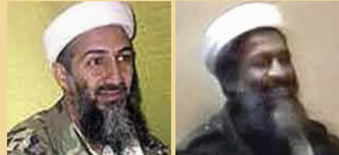
Figure 1: A verified image of bin Laden (left) and a screenshot from the confession tape (right).
The tape was translated by the U.S. government as well as George Michael, a translator for the Diplomatic Language Services, and Dr. Kassem M. Wahba at the Johns Hopkins University. In the tape, bin Laden admitted to having planned and organized the 9/11 attacks.
1.2 Obtaining the Confession Tape and Initial Inspection
To evaluate the video evidence, we first need to recognize that compression can distort images, and it is therefore essential to obtain the video in the highest quality possible. At buyoutfootage.com, I was able to download the tape in high quality [6].
A careful review of the 34-minute-long video in Virtual Dub 2.0 revealed that the oft-repeated comparison was highly deceptive; video compression had evidently severely distorted the facial features. In fact, the man seen in the high-quality video bears a strong resemblance to Osama bin Laden. Consider, for example, these three screenshots (frames 22285, 22305, and 42877) (Fig. 2). In Figure 3, I have presented confirmed images of bin Laden.
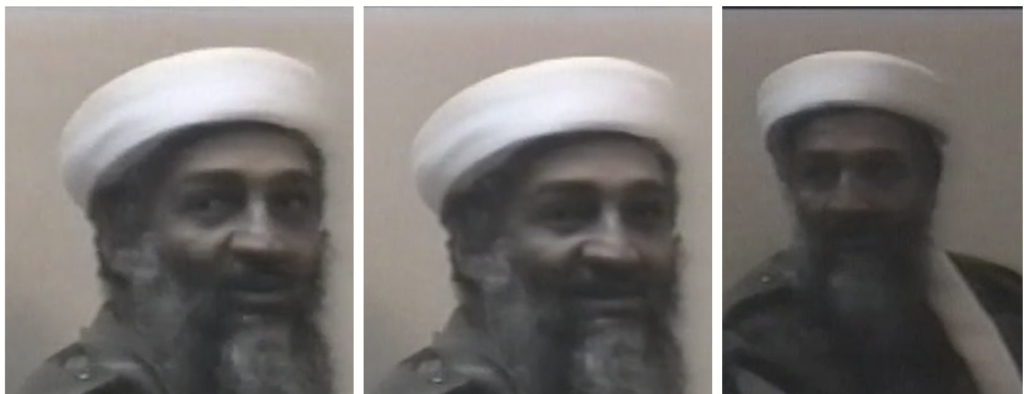
Figure 2: Three screenshots from the confession tape (slightly cropped).
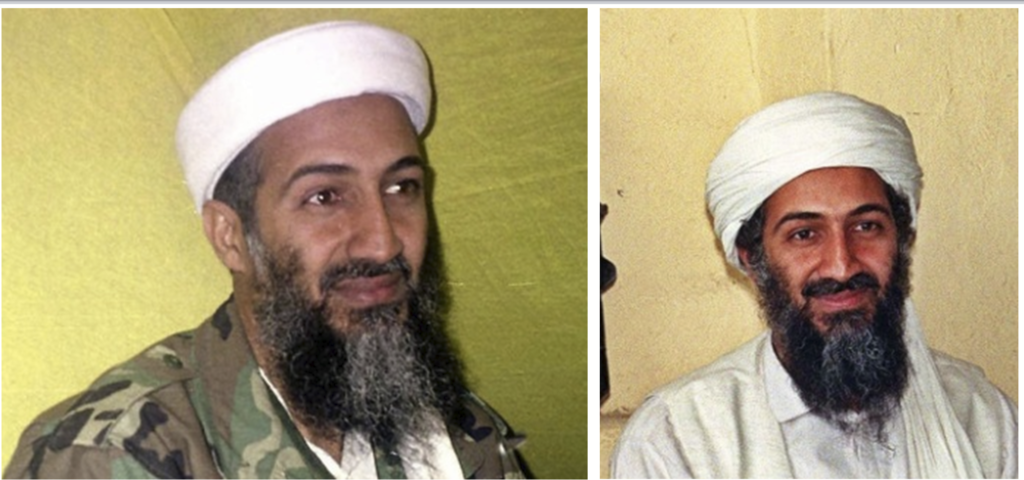
Figure 3: Confirmed Osama bin Laden photos.
1.3 Public Facial Recognition Search Websites
PimEyes offers one of the most accurate facial recognition algorithms. In 2024, for example, it identified Daniela Klette, a former member of the Red Army Faction, from a recent Facebook photo despite having been on the run for decades. After uploading screenshots from the confession tape, such as frame 22285, PimEyes promptly suggested matches with confirmed bin Laden photographs, meaning it had positively identified the man in the tape as bin Laden.
An alternative to PimEyes is FaceComparison ToolPie. The site has a high false negative rate and, therefore, matches are very likely to be de facto positives. For example, the algorithm concluded that a recent and an older picture of actor Clint Eastwood depicted different people (72% face similarity ratio, where 80% is the threshold for identification). With respect to bin Laden, the man depicted in frame 22285 was found to have face similarity ratios of 82% and 84% with the confirmed photos of bin Laden shown in Figure 4, suggesting they are “the same person.” Additional comparisons also yielded positive identifications or borderline ones, e.g., 76%, 77%, and 79% ratios. For comparison, the algorithm only yielded 37% and 47% ratios for Sean Connery and Michael Douglas and their remarkably similar on-screen doubles [7].
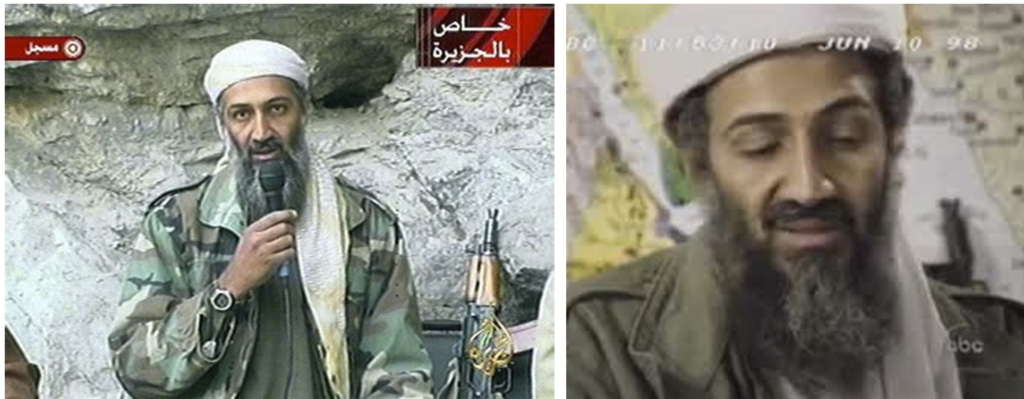
Figure 4: Confirmed photo of bin Laden.
1.4 DeepFace Analysis
To conduct a confirmatory analysis, I wrote a script in Python 3.13 based on DeepFace, a face recognition framework with the following settings: ArcFace, RetinaFace, and Cosine. RetinaFace, which has been shown to outperform all other face detection models contained within the DeepFace architecture, is responsible for face detection and alignment. Subsequently, ArcFace, using advanced mathematics and convolutional neural networks, transforms the visual features of a face into a single vector of 512 dimensions or coordinates with a magnitude or length of exactly 1 (normalization). The vector is then placed within a hypersphere. In simple terms, of those 512 coordinates, the first number might capture the curve of the jawline, the second might capture the depth of the eye sockets, and so on.
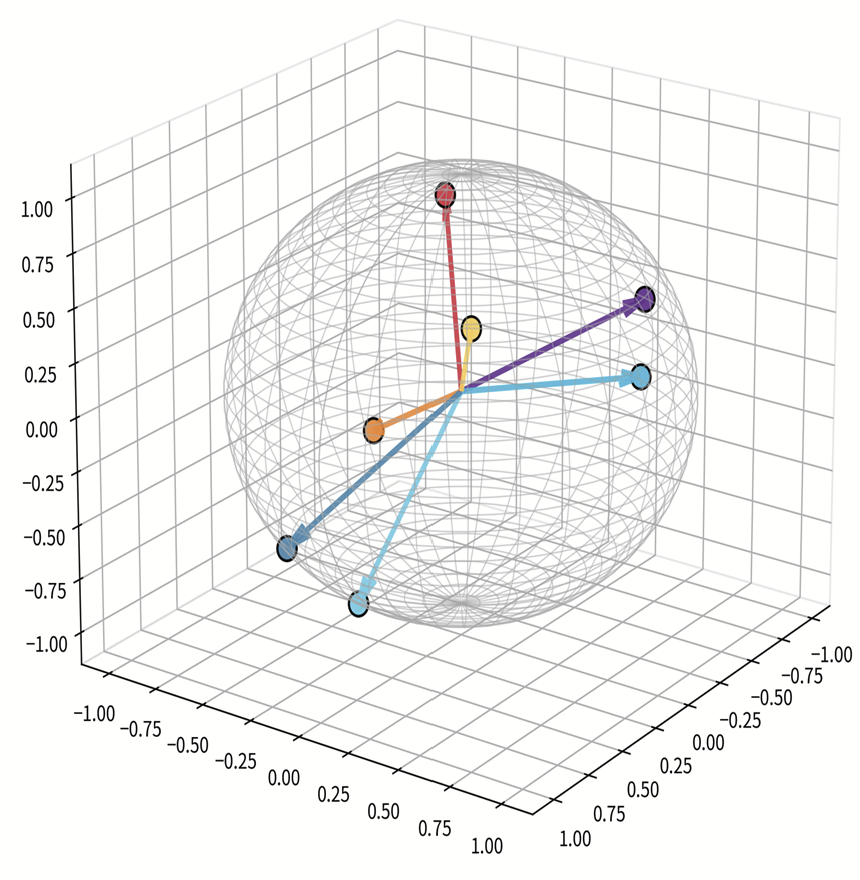
Figure 5: Simplified illustration of a hypersphere.
When the cosine distance between two vectors (1 − cos θ) within the hypersphere is less than a predetermined threshold, there is a high likelihood that those two digital facial fingerprints represent the same person. A distance of 0.0 means the vectors point in the exact same direction (identical facial structures), while a distance closer to 1.0 means the faces are mathematically distinct. The default setting of DeepFace stipulates that a distance equal to or less than 0.68 is a match. Why is each vector forced to have the same magnitude? This ensures that changes in lighting or image quality do not drastically skew the numerical representation of a face.
At first, the script was configured to compare two faces on a Microsoft Windows operating system (see Appendix for the script). The analysis showed that multiple confirmed photographs of Osama bin Laden, including from as far back as 1998, were within the 0.68 threshold regarding frames 22285 and 22305 from the confession tape. The two photos in Figure 6, in particular, scored extremely low with respect to frame 22305 at cosine distances of 0.2925 and 0.4496, meaning we can be highly confident that the man in the confession tape is in fact Osama bin Laden. The two confirmed photographs were first aired by the Saudi-owned television network MBC on April 17, 2002, though the video itself had been recorded the previous year.
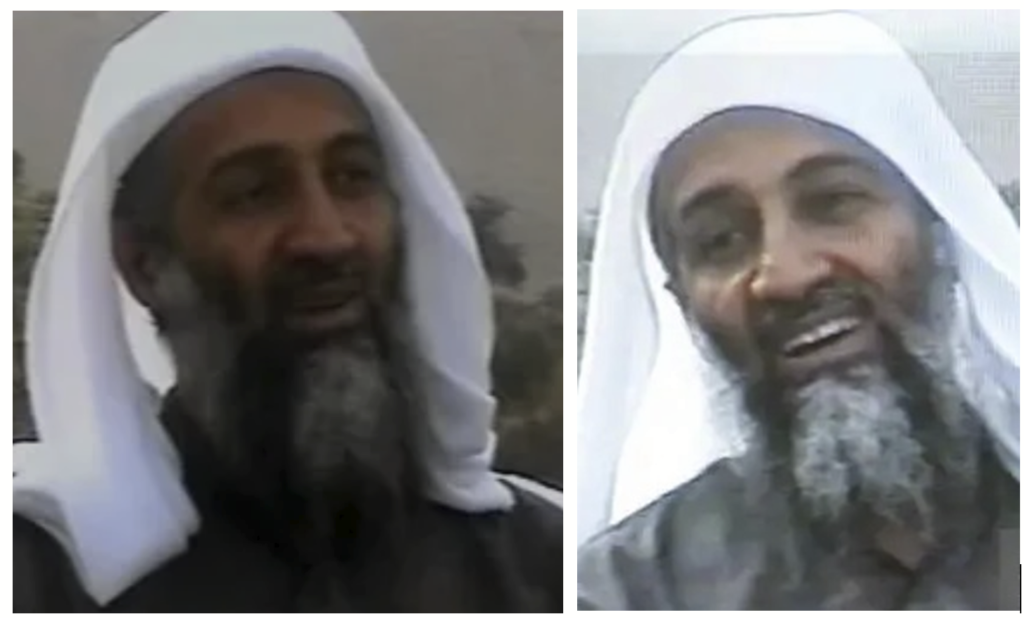
Figure 6: Two confirmed photos of bin Laden.
To test the probability of a random match, I downloaded a database of 202,599 faces of people from across the world, originally collected by researchers at the Chinese University of Hong Kong [8]. I modified the script to search through all the files for faces matching frame 22305 within a strict 0.5 threshold. Within the database, I inserted the two confirmed photos from Figure 6. After several days of analyzing all 202,601 faces, the script returned only two matches: the confirmed photographs. Subsequently, I downloaded a database containing 7,827 Arab faces [9]. In this case, too, there were no matches beyond the two aforementioned confirmed photographs.
1.5 Conclusion
Contrary to allegations surrounding the confession tape, the subject’s facial architecture is mathematically indistinguishable from verified images of Osama bin Laden. The odds of the subject being a lookalike are extremely low. Therefore, the tape and its contents should be regarded as authentic and taken seriously.
Søren Roest Korsgaard is an author and researcher whose publications have appeared in the Scandinavian Journal of Immunology, Health Science Reports, the Journal of 9/11 Studies, the American Journal of Biomedical Science & Research, and others. His new book The New September 11th can be purchased through Amazon https://www.amazon.com/dp/8793987919 and other online retailers.
References
[1]. U.S. Releases Videotape of Osama bin Laden https://2001-2009.state.gov/coalition/cr/rm/2001/6873.htm [accessed June 2026].
[2]. Could the Bin Laden video be a fake? http://news.bbc.co.uk/2/hi/1711288.stm [accessed June 2026].
[3]. Bin Laden videotape was result of a sting https://web.archive.org/web/20240502135821/https://www.theguardian.com/world/2001/dec/16/september11.terrorism1 [accessed June 2026].
[4]. Bin Laden Confession https://911review.com/911review/markup/BinLadenConfession.shtml [accessed June 2026].
[5]. Blurry Video of Man With Osama-like Turban and Beard Proves bin Laden’s Guilt https://911research.wtc7.net/disinfo/deceptions/binladinvideo.html [accessed June 2026].
[6]. Osama bin Laden 9/11 Confession Tape Footage https://www.buyoutfootage.com/pages/titles/pd_td_012.php [accessed June 2026].
[7]. Celebrities Photographed with Their On-Screen Doubles https://lizanest.com/celebrities-photographed-with-their-on-screen-doubles/26/ [accessed June 2026].
[8]. CelebFaces Attributes (CelebA) Dataset https://www.kaggle.com/datasets/jessicali9530/celeba-dataset/data [accessed June 2026].
[9]. Arab Public Figures Facial Recognition https://www.kaggle.com/datasets/ashkhalil/arab-public-figures-facial-recognition [accessed June 2026].
Appendix
from deepface import DeepFace
img1_path = r”…”
img2_path = r”…”
DETECTOR = “retinaface”
print(“Analyzing faces and verifying match…”)
try:
# 2. Compare faces using ArcFace
result_verify = DeepFace.verify(
img1_path=img1_path,
img2_path=img2_path,
model_name=”ArcFace”,
distance_metric=”cosine”,
enforce_detection=True,
detector_backend=DETECTOR
)
distance = result_verify[‘distance’]
custom_threshold = 0.50
is_match = distance <= custom_threshold
print(“\nMATCH VERDICT”)
print(f”Are they the same person?: {str(is_match).upper()}”)
print(f”Raw Facial Distance: {distance:.4f}”)
print(f”Custom Match Threshold: {custom_threshold:.4f} (Distance must be BELOW this to match)”)
print(“\nWHY DID IT MATCH / NOT MATCH?”)
if is_match:
print(f”-> MATCH SUCCESS: The mathematical vector distance ({distance:.4f}) is LESS”)
print(f” than the threshold ({custom_threshold:.4f}).”)
else:
print(f”-> VERIFIED MISMATCH: The distance ({distance:.4f}) EXCEEDS the optimized threshold ({custom_threshold:.4f}).”)
print(f” The variance is too wide to be the same individual.”)
except ValueError as ve:
print(“\nFACE DETECTION ERROR”)
print(f”DeepFace could not find a clear face in one of the images.\nDetails: {ve}”)
print(“Please check that the faces are clearly visible, well-lit, and facing the camera.”)
except Exception as e:
print(f”\nAn unexpected error occurred during analysis: {e}”)