
Download article as audio here:
Søren Roest Korsgaard
Pfizer’s Phase III clinical trial was lauded as a huge success, with media outlets and scientific publications chanting that the vaccine was “highly effective,” “95% effective,” and so forth [1]. The significance of this was rarely clarified, leaving many with the impression that if everyone took two doses, then hospitalizations, deaths, and infections would be reduced by almost 100%. That was not the case; the figure they promoted was a relative risk reduction (RRR).
Relative risks can be highly misleading to the layperson if the absolute risk is very low. Before diving into the substance of the matter, we must first define our terms. To calculate an RRR, one needs to know (i) the event rate in the control group (CER) and (ii) the event rate in the experimental group (EER). Knowing these two, one can proceed to calculate the RRR via:
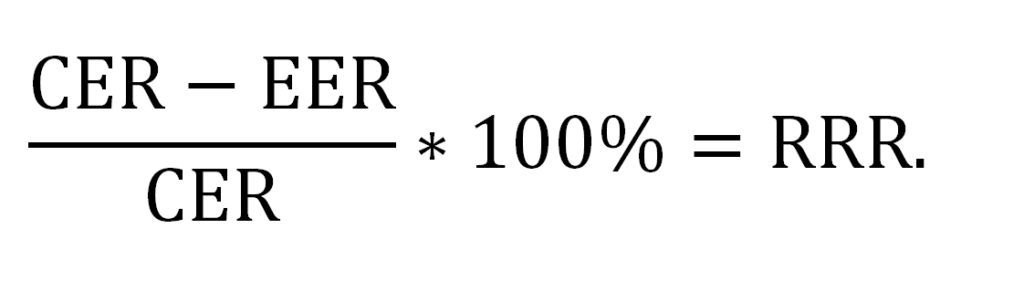
The absolute risk is defined as the probability or chance that a specific event (like testing positive for SARS-CoV-2) will occur in a particular group of people over a defined period. The absolute risk reduction (ARR), which is defined as the difference in absolute risk between a treated group and a control group, is calculated by subtracting the EER from the CER. A related measure is how many people need to be treated (NNT) to avert one case, which is defined as:
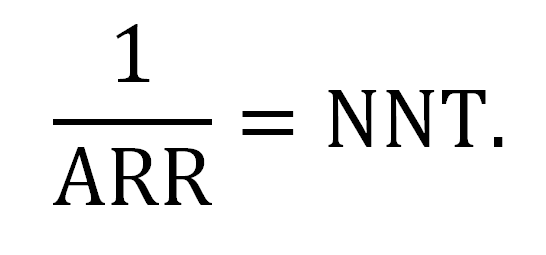
Consider now the hypothetical example of a new drug for atherosclerosis that has been shown in a clinical trial to reduce deaths by 50% compared with the placebo group. It may sound impressive, but as soon as the absolute risk is factored in, a different picture emerges.
If we assume that one in a million, or 0.0001%, dies from atherosclerosis in a control group, the drug will only reduce deaths from two to one per two million people. The ARR, which is rarely quantified by drug companies in their marketing efforts, can be calculated to be a minuscule 0.00005% [2]. As drugs have side effects, often uncertain in scope, the risk-benefit is light-years away from being acceptable. Thus, the RRR was highly misleading due to the low baseline risk.
One can easily see that the significance of the RRR increases proportionally with the absolute risk. Here is a demonstration of it: If 50% of senior citizens have high blood pressure and a new drug reduces it to the normal range with an RRR of 50%, then among 1 million senior citizens, 250,000 cases can be averted. It follows that the NNT is four, meaning that four senior citizens need to be treated to avert one case of hypertension. If the drug harms 1 in 10,000 people, we are left with the following risk-benefit analysis: 100 people will suffer, while 250,000 will benefit. As hypertension is a major contributing factor to deaths from heart attacks and strokes, the drug will save thousands more people than it will harm. In this case, the RRR is not misleading.
Let’s now focus on Pfizer’s Phase III clinical trial, which was primarily concerned with supposedly dangerous health conditions such as “new or increased cough,” “chills,” and “sore throat,” coupled with a positive PCR test [3]. In two groups without evidence of prior infection, Pfizer identified 8 cases among 17,411 people in the vaccine group and 162 cases among 17,511 people who received a placebo injection. Indeed, the data yields an RRR of 95%:

The ARR, on the other hand, is far less impressive at 0.88%, and 114 people need to be double vaccinated to prevent a single case of chills or sore throat combined with a positive PCR test—a far cry from the impression that many had. On a larger scale, only 8,772 of 1 million double-vaccinated people will derive “benefit,” while 991,228 will not. On the dark side, as I show in my book, The New September 11th: Solving the COVID-19 Pandemic, at least 8,000 people will experience a serious adverse event and more than 1,000 may be killed.
Pfizer’s officials also monitored whether some of the cases of sore throat, chills, etc., progressed to severe COVID infections. Reportedly, there was one severe case among the vaccinated and three in the placebo group [3]. Upon realizing this, they calculated that the vaccine reduced severe COVID by almost 70%. In the words of distinguished scientist Dr. Sucharit Bhakdi, the clinical trial showed “absolutely zero” benefit, and “people don’t understand that they’re being fooled and have been fooled all along” [4].
In keeping with Pfizer’s long criminal history, evidence that the Phase III clinical trial was laced with scientific misconduct soon surfaced. The first major revelation came on November 2, 2021. The BMJ reported that Brook Jackson, a clinical trial auditor, had come forward with evidence of fraud [5-6]. Jackson worked for the Ventavia Research Group, which Pfizer had hired to oversee trial participants at several locations in Texas. While Ventavia’s website portrays itself as having superior standards, Jackson was horrified by massive misconduct [7]. She repeatedly informed her superiors, who took no action, and within hours of informing the FDA on September 25, 2020, she was fired. Fortunately, she secured dozens of documents, photographs, audio recordings, and other forms of evidence. It proved that Ventavia falsified data, unblinded patients, failed to store vaccines at the appropriate temperature, and delayed following up on adverse events [5].
The BMJ also noted that an FDA review memorandum stated that, across all sites, 477 people with suspected symptomatic COVID were not tested. Given Pfizer’s reported case numbers (eight in the vaccinated group and 162 in the placebo group), ignoring 477 possible cases would have had a major impact on the final efficacy analysis. It should come as no surprise that Pfizer hired Ventavia as a research subcontractor for four other vaccine-related clinical trials.
What about FDA oversight that is supposed to prevent such fraud? During the entire clinical trial, the agency only showed up at nine out of 153 sites; Ventavia’s sites were not among those “inspected.” Jill Fisher, a professor of social medicine who has researched clinical trials, clarified to The BMJ what an FDA inspection means: “The agency rarely does anything other than inspect paperwork, usually months after a trial has ended” [5]. In other words, “There’s just a complete lack of oversight of contract research organizations and independent clinical research facilities” [5].
Jackson later sued Pfizer and Ventavia under the False Claims Act for fraud. The lawsuit has predictably been dismissed, but it remains ongoing at the appellate level. The trial documents, which are available on Jackson’s website, offer detailed insights [8]. According to an Appellant’s Opening Brief filed on February 14, 2025, she alleged that Pfizer committed massive fraud from the design of the three clinical trials to the end product [9]. Among many points, Pfizer intentionally allowed the vaccines to degrade in order to “hide adverse events in the treatment group,” deceptively counted non-vaccinated as vaccinated, failed to report adverse events, applied inclusions and exclusions to sculpt the data, and used flawed PCR tests that enabled it to reach desired results.
That Pfizer’s clinical trial turned out to be saturated with fraud was predictable. Years earlier, Dr. Peter Gøtzsche, a leading critic of the drug industry and co-founder of Cochrane Collaboration, issued a loud and clear warning: “We cannot trust industry trials at all” [10].
Søren Roest Korsgaard is an author and researcher whose publications have appeared in the Scandinavian Journal of Immunology, Health Science Reports, the Journal of 9/11 Studies, the American Journal of Biomedical Science & Research, and others. The New September 11th can be purchased through Amazon https://www.amazon.com/dp/8793987919 and other online retailers.
References
[1]. Updated Pfizer Data Shows Vaccine Is 95% Effective https://www.webmd.com/vaccines/covid-19-vaccine/news/20201118/updated-pfizer-data-shows-vaccine-is-95-effective [accessed November 2022].[2]. Jiroutek, Michael R, and J Rick Turner. “Relative vs absolute risk and odds: Understanding the difference.” Journal of clinical hypertension (Greenwich, Conn.) vol. 21,6 (2019): 859-861. doi:10.1111/jch.13548 https://pmc.ncbi.nlm.nih.gov/articles/PMC8030315/ [accessed May 2025].
[3]. FDA Briefing Document Pfizer-BioNTech COVID-19 Vaccine (see Table 6 on page 24) https://www.fda.gov/media/144245/download?fbclid=IwAR3FNVjqWO1lmPCcskScFn4u-KWIyrD0NUQp6XRyq76dwhSVXYHgo-VVxqQ [accessed September 2021].
[4]. Sucharit Bhakdi: COVID-19 vaccination is greatest threat humanity ever faced https://hannenabintuherland.com/usa/sucharit-bhakdi-covid-19-vaccination-is-greatest-threat-humanity-ever-faced/ [accessed July 2021].[5]. Thacker, Paul D. “Covid-19: Researcher blows the whistle on data integrity issues in Pfizer’s vaccine trial.” BMJ (Clinical research ed.) vol. 375 n2635. 2 Nov. 2021, doi:10.1136/bmj.n2635 https://pubmed.ncbi.nlm.nih.gov/34728500/ [accessed November 2021].
[6]. Pfizer Knew | Clinical Trial Fraud Exposed https://rumble.com/v4cdf86-pfizer-knew-clinical-trial-fraud-exposed.html [accessed October 2025].[7]. Ventavia https://www.ventaviaresearch.com/ [accessed November 2021].
[8]. Case documents https://www.iambrookjackson.com/casedocuments [accessed May 2025].
[9]. Appellant’s Opening Brief https://www.iambrookjackson.com/_files/ugd/9df0bc_d924cf232fea44668fd90fcc91e0d26a.pdf [accessed May 2025].
[10]. Gøtzsche, Peter C. Deadly Medicines and Organised Crime: How Big Pharma Has Corrupted Healthcare. CRC Press, 2013.